No products in the cart.
View collectionTại sao Rolex Cosmograph Daytona trở thành biểu tượng quyền uy và xa xỉ trong ngành đồng hồ?
Explore the more than 60-year history of the Rolex Cosmograph Daytona. This guide explains in detail how to use the chronograph function, read the tachymeter scale, and follow important maintenance practices correctly.
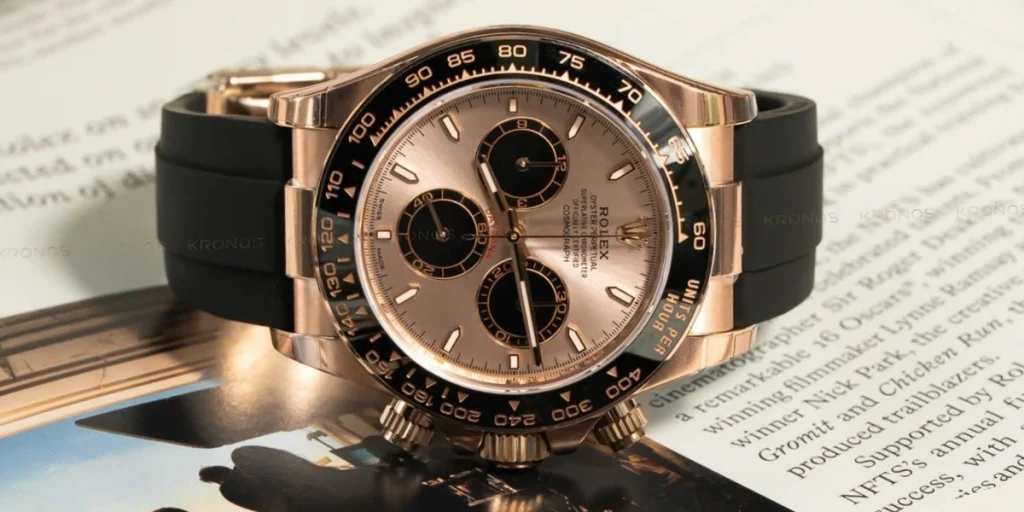
The Rolex Cosmograph Daytona is a high-end Swiss sports chronograph, introduced in 1960 to serve the world of motor racing. Its name originated from Daytona Beach in Florida, USA, and the model later became closely associated with legendary actor Paul Newman.
From a technical perspective, the collection features a 100-meter water-resistant Oyster case, three subdials, a Cerachrom bezel engraved with a tachymeter scale, and the self-winding Calibre 4130 movement with 290 components and an accuracy of just ±2 seconds per day.
This article examines how the watch operates, criteria for distinguishing authentic models from counterfeits, comparisons with the Omega Speedmaster, maintenance-related risks, and situations in which owning a Daytona may not be suitable.
What Has Shaped the History and Distinctive Status of the Rolex Cosmograph Daytona?
More than 60 years of history closely linked to motor racing, the legacy of Paul Newman, and major technical innovations have given the Rolex Cosmograph Daytona a distinctive position in the luxury sports watch industry.
When Was the Rolex Cosmograph Daytona Introduced, and What Historical Legacy Does It Carry?
First introduced in 1960, the Rolex Daytona was designed as a precision timekeeping instrument for racing drivers. Its name is closely associated with Daytona Beach in Florida, USA – a cradle of high-speed motor racing and the place where legendary actor Paul Newman left an enduring legacy with the watch that would later become closely associated with his name.
Daytona Beach had hosted automobile races since 1903, with drivers repeatedly breaking world speed records on its 37-kilometer stretch of hard-packed sand. Rolex developed a specialized watch to meet the precise timing needs of professional racing drivers on the track. The model incorporated an accurate chronograph function and a tachymeter scale on the bezel, allowing drivers to calculate average speed within seconds.
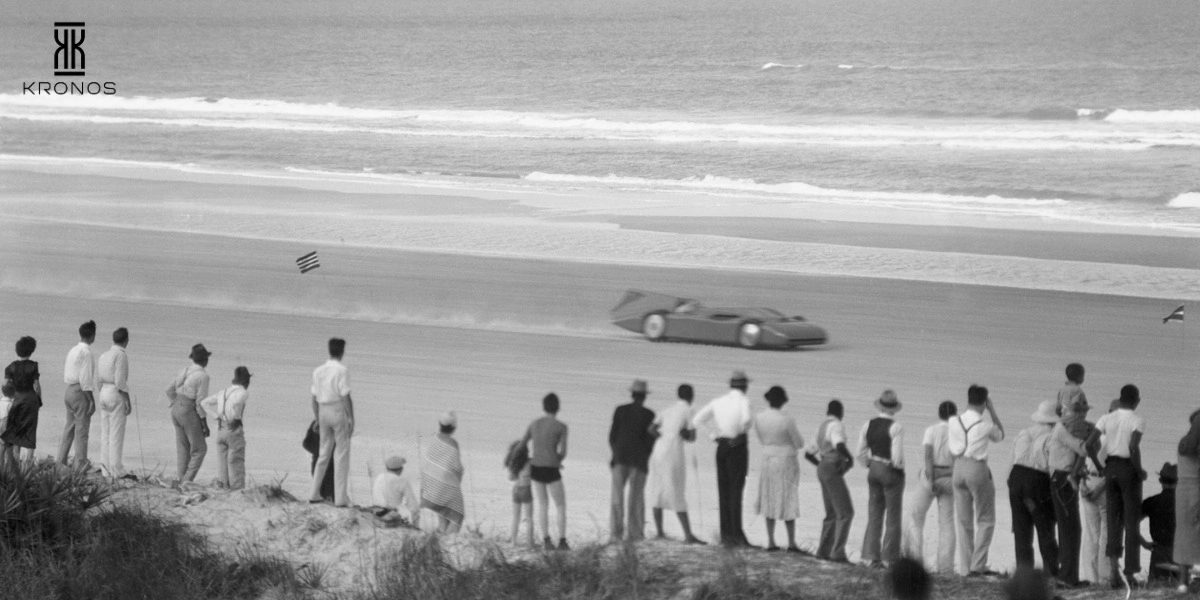
Daytona Beach – a historic venue for high-speed motor racing events
In 1992, Rolex marked an important milestone by officially becoming the Title Sponsor of the Rolex 24 At DAYTONA, one of the world’s most prestigious motorsport events. Since 1992, the connection between Rolex and motorsport has been reinforced through more than 30 consecutive years as the Title Sponsor of the 24-hour race at Daytona.
Actor and racing driver Paul Newman wore the Rolex Daytona Ref. 6239 with an “Exotic” dial from the late 1960s until his death in 2008. The watch was later auctioned for a record-breaking USD 17.8 million in 2017, becoming the most expensive watch ever sold at auction at that time. This event elevated the Rolex Daytona beyond the realm of a conventional timepiece, turning it into a pop-culture icon with significant historical and artistic value.
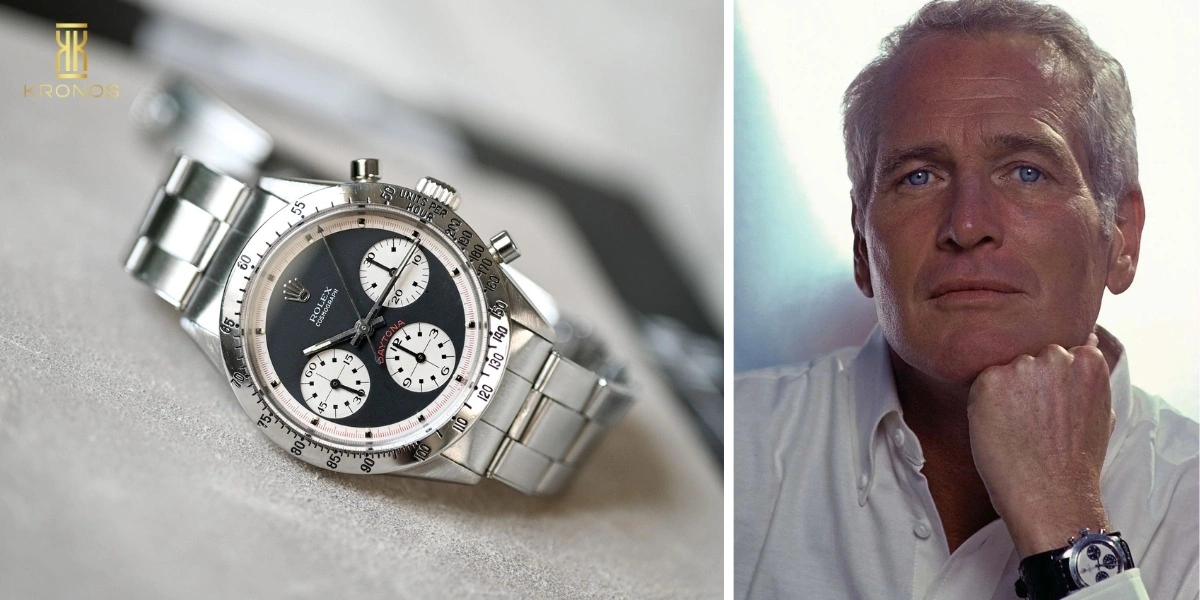
The Rolex Daytona Ref. 6239 worn by actor and racing driver Paul Newman
What core design elements and technical features define the prestige of the Rolex Daytona?
The Daytona stands out with its signature Oyster case, water-resistant to 100 metres, a chronograph function with three sub-dials, and a bezel featuring a precise tachymetric scale. Its automatic Calibre 4130 movement meets Rolex’s Superlative Chronometer standard, maintaining an accuracy of just ±2 seconds per day-more precise than the conventional COSC standard of approximately −4/+6 seconds per day.
Rolex applies the philosophy of “Form follows Function”, meaning that every design detail serves a specific practical purpose. The Oyster case is crafted from Rolex’s proprietary Oystersteel, a 904L-grade steel with superior corrosion resistance compared with conventional 316L steel, while also delivering the robust appearance associated with a sports watch.
The brand manufactures the Cerachrom bezel from a single piece of high-tech ceramic. This material is four times harder than conventional steel, offers high scratch resistance, and retains its colour even when exposed to ultraviolet rays or chemicals.
The tachymetric scale is laser-engraved with micron-level precision, allowing the wearer to calculate average speed over a fixed distance of 1 kilometre. It is an essential tool for those who genuinely use the watch on the racetrack, rather than simply admiring it as a luxury timepiece.
In addition, the Calibre 4130 movement is produced entirely in-house. Introduced in 2000, it replaced the Zenith El Primero movement used in earlier Daytona models. Launched in 2000, this movement succeeded the Zenith El Primero calibre that had powered previous generations of the Daytona.
The Calibre 4130 features a streamlined architecture with only 290 components—around 100 fewer parts than its predecessor—thanks in part to its distinctive vertical clutch design. The vertical clutch allows the chronograph seconds hand to start smoothly without jumping or vibration, enabling accurate timing from the very first second.
The three sub-dials are harmoniously arranged on the main dial: the sub-dial at 3 o’clock records hours, the one at 6 o’clock displays continuous seconds, or small seconds, and the one at 9 o’clock records minutes. The hands and hour markers are coated with Chromalight luminescent material, which emits a blue glow for more than eight hours, making the watch easier to read in low-light conditions.
The crystal is made from scratch-resistant sapphire and features an anti-reflective coating to provide a clear view of the dial. In addition, the Triplock screw-down crown uses a triple-sealing system to help prevent water from entering the movement.
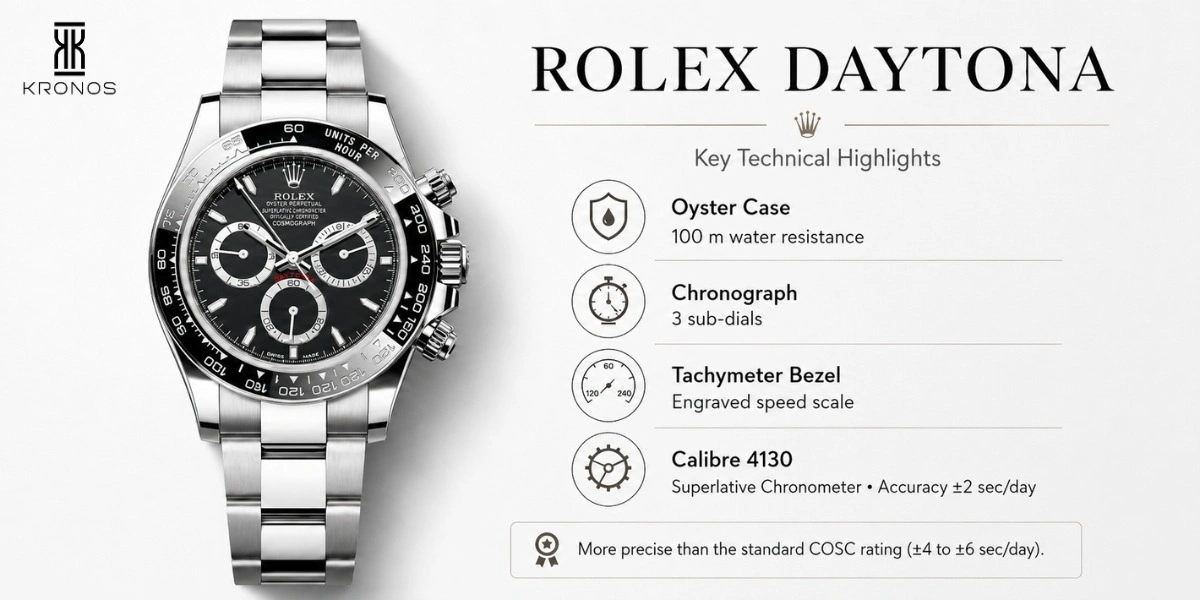
Key design and technical features of the Rolex Cosmograph Daytona
How do you operate the chronograph and Tachymeter scale on the Rolex Daytona?
The Rolex Cosmograph Daytona is equipped with a chronograph function combined with a Tachymeter scale on the bezel. This system allows the wearer to measure elapsed time and calculate average speed over a fixed distance.
Step 1: Unscrew the two Chronograph pushers
Before using the chronograph, the wearer must unlock the two screw-down pushers located at 2 o’clock and 4 o’clock.
- Turn the locking ring of each pusher counterclockwise.
- Continue turning until the locking ring is fully released.
- There is no need to unscrew the Triplock winding crown at 3 o’clock to use the chronograph.
The screw-down locking mechanism helps prevent the pushers from being activated accidentally during movement, impact, or while the watch is being used in water.
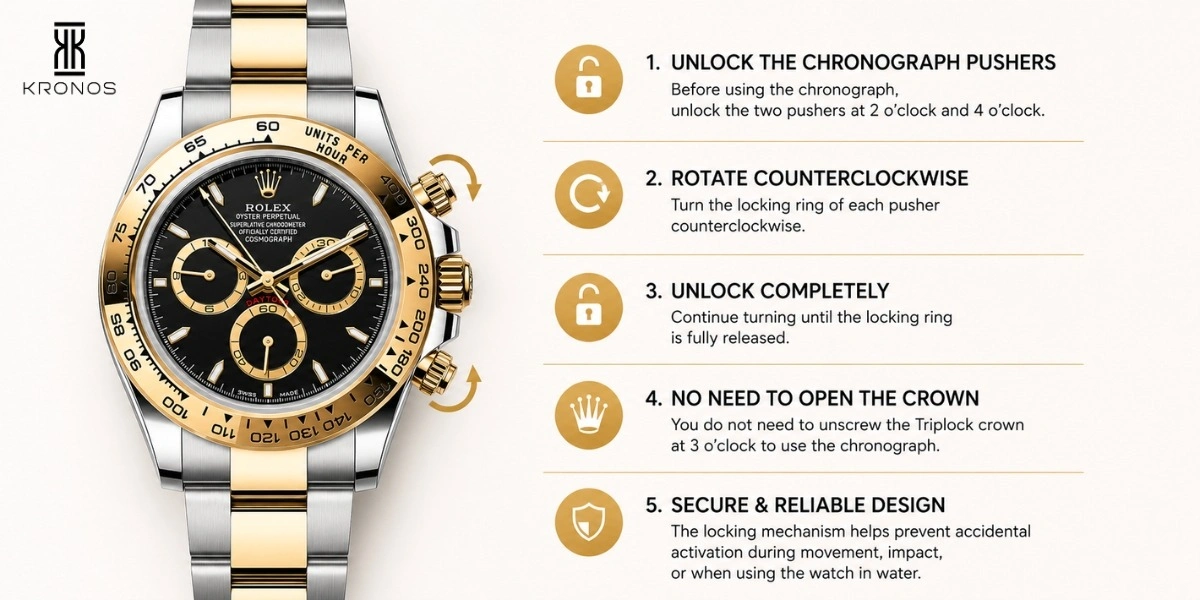
How to unlock the two Chronograph pushers
Step 2: Start the Chronograph
Once the pushers are unlocked, press the pusher at 2 o’clock to begin timing.
At this point:
- The central Chronograph seconds hand begins moving from the 12 o’clock position.
- The sub-dial at 3 o’clock records the elapsed minutes.
- The sub-dial at 9 o’clock records the elapsed hours.
- The sub-dial at 6 o’clock generally serves as the continuous running seconds display.
On many modern generations of the Rolex Daytona, the vertical clutch mechanism allows the Chronograph hand to start smoothly while minimizing jumping or vibration when timing begins.
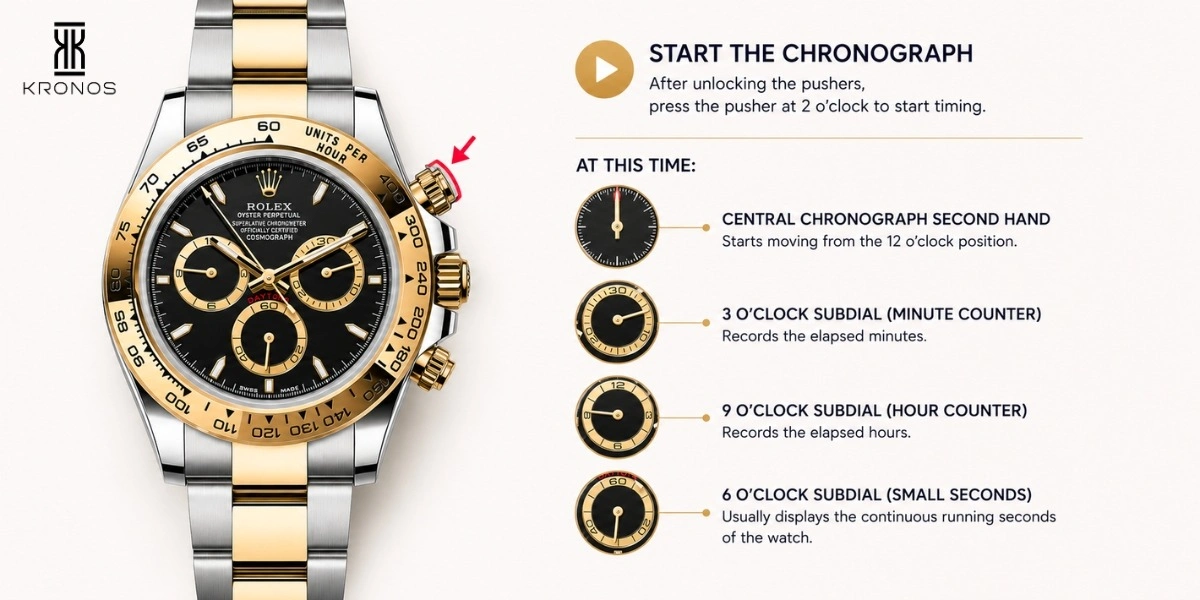
Start the Chronograph using the pusher at 2 o’clock
Step 3: Stop the timing operation
When you want to end the measurement, press the pusher at 2 o’clock again. The central Chronograph seconds hand and the elapsed-time counters will stop at the measured result.
The wearer can then read:
- Seconds from the minute track on the main dial.
- Minutes from the sub-dial at 3 o’clock.
- Hours from the sub-dial at 9 o’clock.
This function can be used to measure a racing lap, a training session, a meeting, or any task that requires precise time tracking.
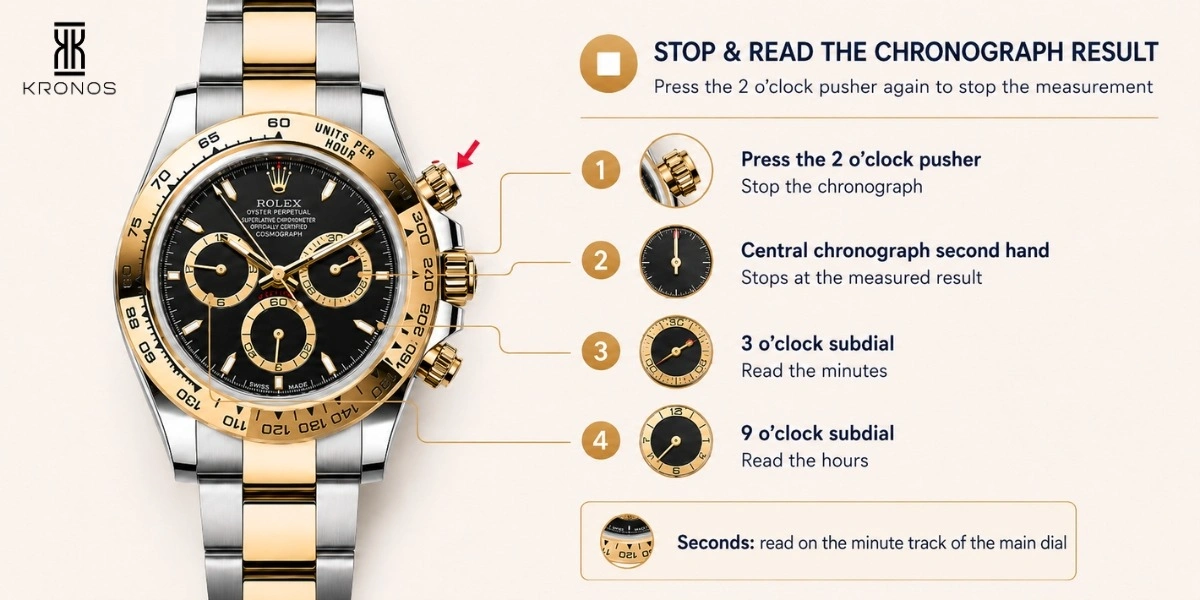
Press the pusher at 2 o’clock again to stop timing and read the result
Step 4: Measure speed using the Tachymeter scale
The Tachymeter scale on the bezel can be used to calculate average speed based on the time required to cover a fixed distance, most commonly 1 kilometre or 1 mile.
- Identify a course with an exact length of 1 kilometre.
- As the vehicle passes the starting point, press the pusher at 2 o’clock to start the Chronograph.
- When the vehicle completes the 1-kilometre distance, press the pusher at 2 o’clock again to stop timing.
- Observe where the central Chronograph seconds hand points on the Tachymeter scale.
- The number indicated by the hand represents the vehicle’s average speed.
For example:
- The vehicle completes 1 kilometre in 20 seconds.
- The central Chronograph seconds hand stops at 180 on the Tachymeter bezel.
- The corresponding average speed is 180 km/h.
The Tachymeter operates according to the following formula:
Average speed = 3,600 ÷ number of seconds required to complete 1 kilometre
This scale is most suitable for activities completed in less than 60 seconds. If the elapsed time exceeds one minute, reading the result directly from the bezel becomes less convenient.
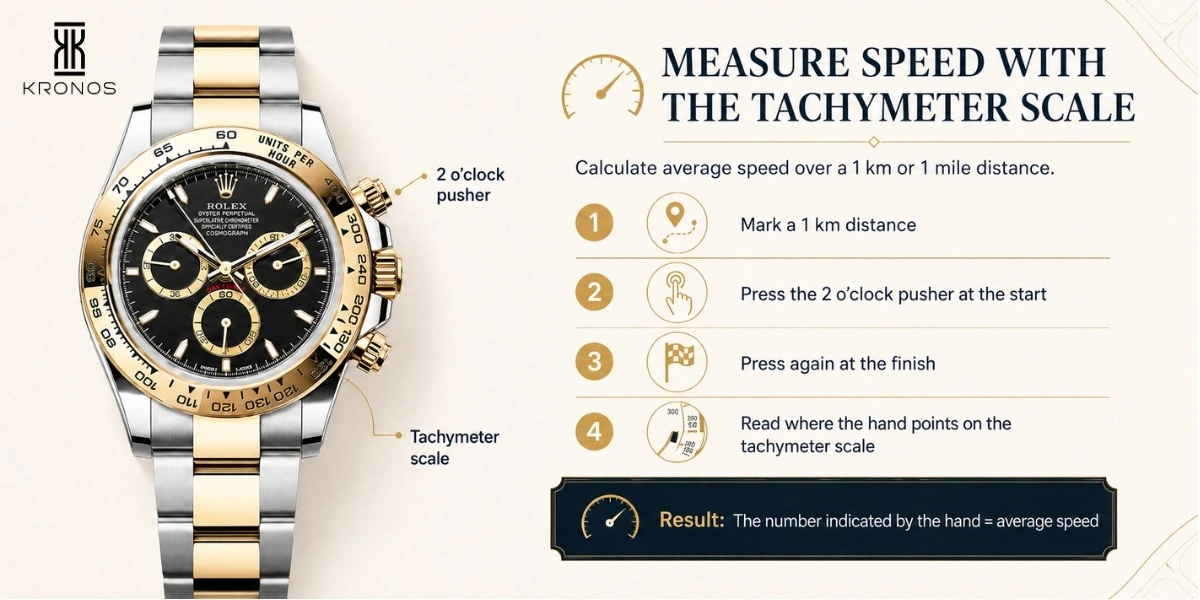
How to measure speed using the Tachymeter scale
Step 5: Reset the Chronograph hands to their original positions
After stopping the Chronograph, press the pusher at 4 o’clock to reset the system.
The following will occur:
- The central Chronograph seconds hand returns to 12 o’clock.
- The minute counter returns to 0.
- The hour counter returns to 0.
Do not press the reset pusher while the Chronograph is still running. Stop the timing operation first using the pusher at 2 o’clock, then press the pusher at 4 o’clock to reset the system.
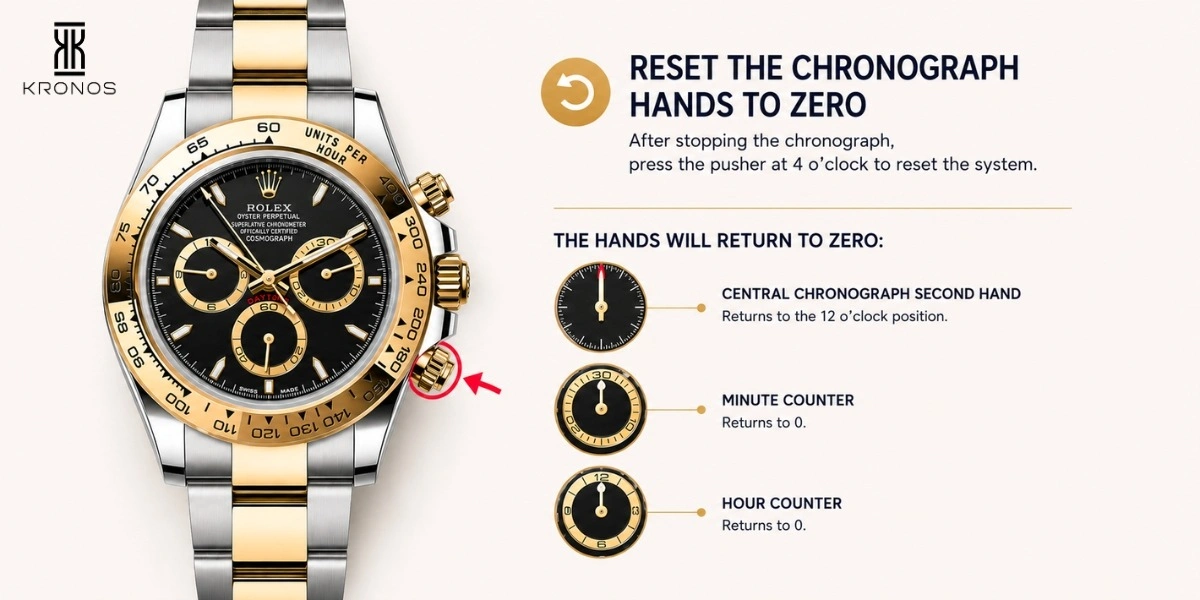
After stopping the Chronograph, reset the hands to their original positions
Step 6: Screw the pushers back down
After use, the two Chronograph pushers should be screwed down again.
- Turn the locking ring of each pusher clockwise.
- Continue turning until the locking ring sits securely against the case.
- Do not apply excessive force, as this could affect the screw threads.
Securing the pushers helps maintain water resistance and protects the Chronograph mechanism from accidental operation.
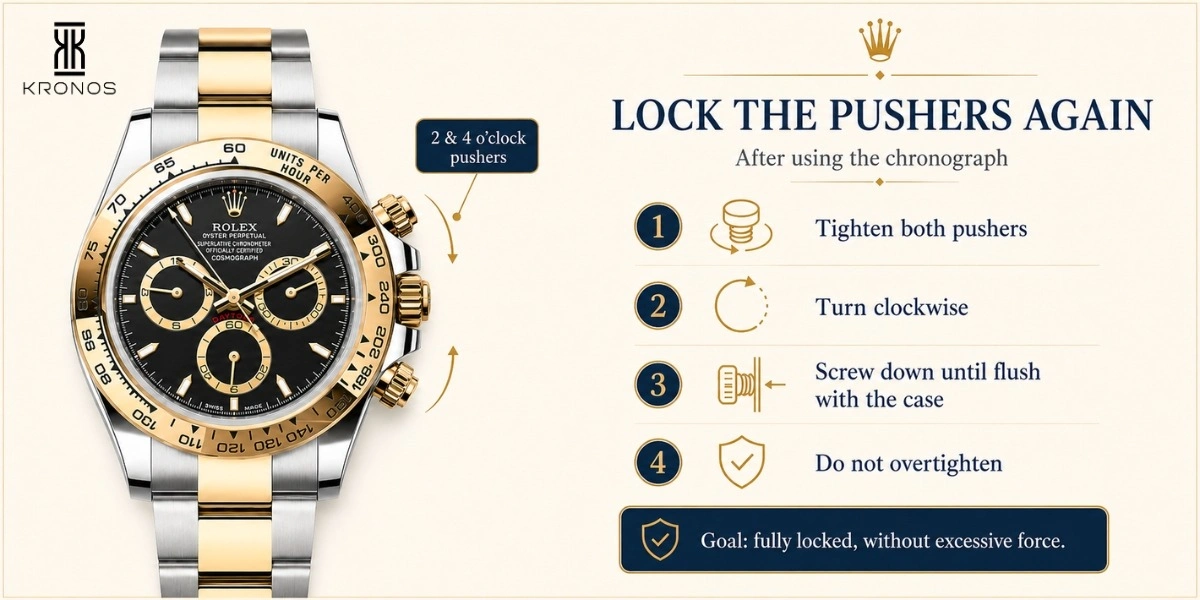
After use, screw down both Chronograph pushers securely
*Note: The hands and hour markers are coated with Chromalight luminescent material, which emits a blue glow and helps maintain legibility in low-light conditions for more than eight hours. Unlike traditional Super-LumiNova, which typically emits a green glow, Rolex Chromalight produces a distinctive blue light and maintains its brightness for longer, making it particularly useful when driving at night or taking part in endurance races lasting several hours.
What factors determine the price differences among Rolex Daytona versions?
The price of a Daytona depends heavily on the material used – such as stainless steel, two-tone, or solid gold – the dial design, and overall scarcity. In particular, stainless-steel Daytona models often trade on the secondary market at two to three times their retail price due to Rolex’s deliberately limited production and the resulting multi-year waiting lists.
The luxury watch market operates according to supply and demand, while Rolex tightly controls production to help maintain stable values on the secondary market. Rolex produces approximately 800,000 watches per year, with Daytona models estimated to account for less than 10%, equivalent to around 50,000 – 80,000 watches across all versions. This contributes to prolonged global scarcity.
Rolesor, Rolex’s proprietary combination of Oystersteel and 18K gold, is one of the first factors influencing price. Two-tone Daytona models, also known as Rolesor, such as reference 116503, combine stainless steel with yellow gold and have an official retail price of approximately USD 18,000–20,000. On the secondary market, however, prices may rise to USD 25,000 – 30,000 depending on condition and dial rarity.
By contrast, solid 18K gold models such as reference 116508 have retail prices starting from USD 35,000. Interestingly, despite the higher intrinsic value of gold, the all-steel reference 116500LN is significantly harder to obtain. Rolex reportedly prioritizes the allocation of gold watches to VIP customers or buyers with a long purchase history, while steel models are often reserved for waiting lists – where even wealthy buyers may have to remain patient.
The waiting-list phenomenon has become part of Rolex collector culture. At authorized dealers, customers may register their names and wait for years without any guaranteed delivery date. Some buyers have reportedly waited three to five years without receiving a call. This has created a highly active parallel market in which secondary-market dealers are willing to pay substantial premiums to acquire watches from customers fortunate enough to receive an allocation.
Reference price table for popular Rolex Daytona models as of 2026:
| Reference | Material | Dial | Retail Price (USD) | Secondary Market Price (USD) |
| 116500LN | Oystersteel | White/Black | ~14,000 | 35,000–45,000 |
| 116503 | Rolesor (Steel + Yellow Gold) | White/Champagne | ~18,500 | 25,000–32,000 |
| 116508 | 18K Yellow Gold | Green/Champagne | ~36,000 | 42,000–55,000 |
| 116519LN | 18K White Gold | Blue | ~42,000 | 50,000–65,000 |
| 116506 | Platinum | Ice Blue | ~75,000 | 90,000–120,000 |
*Note: Secondary-market prices fluctuate continuously depending on demand and the condition of the watch. Models with special dials or limited production may command significantly higher prices.
The final factor is dial design. “Panda” dials, featuring a white background with black sub-dials, and “Reverse Panda” dials, featuring a black background with white sub-dials, are consistently more sought after than monochromatic designs. This reflects modern aesthetic preferences for strong contrast, easy legibility, and iconic styling.
Watch enthusiasts with a budget of USD 18,000 – 20,000 may consider a Rolesor version combining steel and gold. However, for those focused on long-term investment and high liquidity, the stainless-steel reference 116500LN remains the strongest option in terms of value retention and long-term appreciation according to the source text.
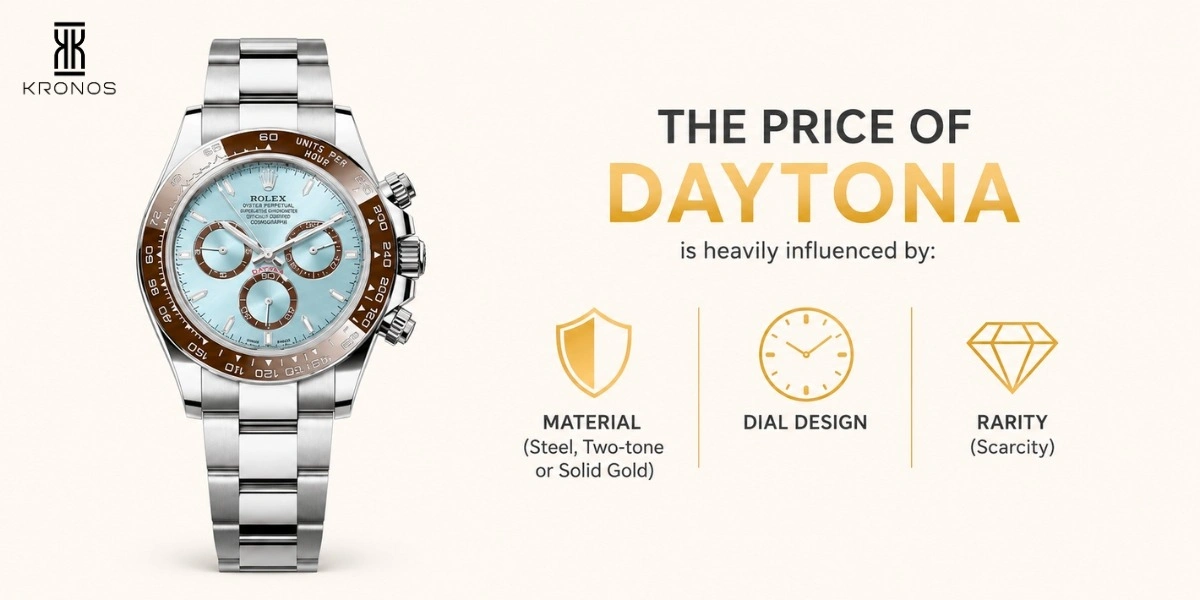
The price of the Rolex Cosmograph Daytona depends on its material, dial design, and scarcity.
What important risks and considerations should be understood before investing in a Rolex Cosmograph Daytona?
The three main risks when investing in a Rolex Daytona include movement damage caused by high-impact sports, loss of value from neglecting periodic servicing every five to seven years, and financial losses when buying at the peak of the market.
What common mistakes can reduce the value of a Rolex Daytona or damage its movement?
Owners often make the mistake of wearing the watch while playing high-impact sports such as golf or tennis, potentially damaging the mechanical movement. Neglecting routine servicing can also cause lubricants to dry out, increasing component wear and reducing movement accuracy.
Many people mistakenly assume that a sports watch can withstand every type of sporting activity. Although the Rolex Daytona is designed for durability, the mechanical movement inside remains highly sensitive to sudden impacts.
When playing golf, each time the club strikes the ball it can generate forces of up to 100 – 200G, which are transmitted through the wrist and into the movement. These forces may misalign wheel pivots, damage the balance spring, or loosen securing screws. Such damage may not be immediately noticeable but can gradually reduce accuracy.
Tennis can create similar shocks with every powerful racket stroke. Activities such as hammering nails, using a mallet, or operating handheld tools may also transmit G-forces directly into the movement. According to the source text, Rolex Service Centre recommends removing the watch before participating in repetitive or high-intensity impact activities.
For people who genuinely need a sports watch for extreme activities, a quartz watch or smartwatch may be more suitable than exposing a mechanical movement worth tens of thousands of dollars to unnecessary risk.
The second common mistake is neglecting periodic servicing. According to the source text, Rolex recommends servicing mechanical watches every five to seven years at an authorized service centre. During servicing, technicians disassemble the entire movement, clean each component using specialized ultrasonic solutions, replace the lubricants, and test water resistance. Costs are stated as ranging from USD 800 to USD 1,500, but the source describes this as a necessary investment for maintaining the value of the watch.
Lubricants inside a mechanical watch have a limited lifespan. Over time, they oxidize, thicken, and lose their lubricating properties. As a result, friction between gears increases and accelerates component wear. The source states that a Daytona left unserviced for ten years may lose 30–50% of its accuracy and 20–30% of its resale value due to the need for major repairs.
In addition, many consumers mistakenly believe that 100-metre water resistance means the watch can safely dive to a depth of 100 metres. The source explains that this figure represents static pressure under laboratory conditions. Swimming or jumping into water can generate much greater dynamic pressure.
Water may enter the movement during handwashing if the wearer forgets to tighten the Triplock crown after using the Chronograph. Therefore, always check that the crown is secured before contact with water and avoid pressing the Chronograph pushers while underwater.
In what situations is the Rolex Cosmograph Daytona not a suitable choice?
The Daytona may not be suitable as a traditional dress watch when worn with a formal tuxedo because of its thickness and sporty character.
At formal occasions such as black-tie weddings or charity galas, a slim dress watch with a simple dial and leather strap may be more appropriate. With its 12.5 mm thickness and distinctly sporty bezel, the Daytona can appear visually excessive when paired with cufflinks and a silk shirt. In such situations, models such as the Rolex Cellini or Patek Philippe Calatrava may provide a more traditional formal aesthetic.

The Daytona may not be suitable for highly formal occasions such as weddings and gala events.
From an ergonomic perspective, the Daytona’s 40 mm diameter and approximately 48 mm lug-to-lug measurement may be too large for people with wrist circumferences under 14 cm. When the watch extends beyond the edges of the wrist, it can look disproportionate and may become uncomfortable during movement. Collectors with smaller wrists may consider watches measuring 36–38 mm or models with shorter lugs for improved comfort and proportion.
For diving enthusiasts, the Daytona is not designed as a professional deep-diving watch. Although it offers 100-metre water resistance, the source recommends purpose-built models such as the Rolex Submariner, with 300-metre water resistance, or the Sea-Dweller, with 1,220-metre water resistance and a helium escape valve.
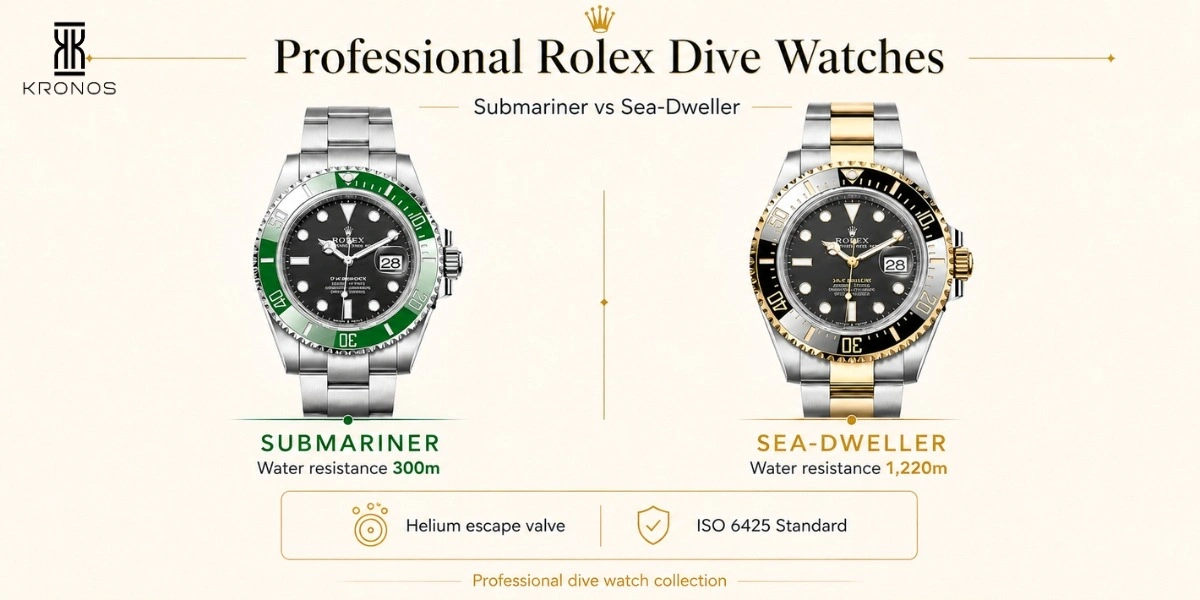
Professional watch collections designed for diving.
Finally, the Daytona may not be suitable for buyers seeking a quick “buy and immediately resell” profit. Although the secondary market is highly active, it is also volatile. Owners may incur losses if they buy near a market peak—for example, when the 116500LN reached around USD 50,000 in 2021–2022—and are then forced to sell after prices decline by 20–30%. The source therefore frames the Daytona as a medium- to long-term investment of five to ten years or more rather than a short-term speculative instrument.
FAQ: Frequently Asked Questions About the Rolex Cosmograph Daytona
How can you distinguish a genuine Rolex Daytona from a fake?
According to the source text, five factors should be checked when identifying an authentic Daytona: the distinctive finish of the 904L Oystersteel case, the Cerachrom ceramic bezel described as highly scratch-resistant, the finely laser-engraved serial number, the smooth operation of the Calibre 4130 movement with a continuously sweeping seconds hand, and complete certification documents from an authorized Rolex dealer.
How long can a Rolex Daytona run without being wound?
The Daytona’s Calibre 4130 movement has a power reserve of approximately 72 hours, or three days, when fully wound. Thanks to its automatic winding mechanism, the watch winds itself through the wearer’s daily wrist movements. If it is not worn, the movement can be manually wound using the Triplock crown.
Rolex Daytona vs. Omega Speedmaster: which one should you choose?
The Daytona is a high-end automatic chronograph equipped with the Calibre 4130 movement containing 290 components, an Oyster case with 100-metre water resistance, and a Cerachrom ceramic bezel. According to the source text, stainless-steel models trade at approximately USD 35,000–45,000 on the secondary market.
The Omega Speedmaster Professional uses the manually wound Calibre 1861, is associated with the 1969 Moon landing, and is listed in the source at approximately USD 6,000–8,000.
Choosing between the two depends on your budget, aesthetic preferences, and collecting goals.
Why is it so difficult to buy a new Rolex Daytona from an authorized dealer even if you can afford one?
The source states that Rolex uses selective distribution and limits the number of Daytona watches allocated to each authorized dealer every year. Priority may be given to VIP customers with long purchasing histories or customers who have previously bought several other Rolex products.
In addition, global demand significantly exceeds supply, meaning waiting lists at authorized dealers can reportedly extend from three to five years without any guarantee of allocation. The source presents this scarcity as part of Rolex’s strategy for maintaining brand value.
If you would like to bypass the waiting list and purchase a brand-new Daytona—100% new, full box, with a recent warranty date—the source recommends Kronos Luxury Timepieces. The store offers full-box Daytona models with complete international warranty documentation and consultation services.
You can visit the store at 08 Phùng Khắc Khoan Street, Sài Gòn Ward, Ho Chi Minh City, open from 10:00 AM to 6:00 PM, Monday through Sunday, for direct assistance.